Low air volume through AC vents
#1
Posted 18 June 2010 - 09:53 PM
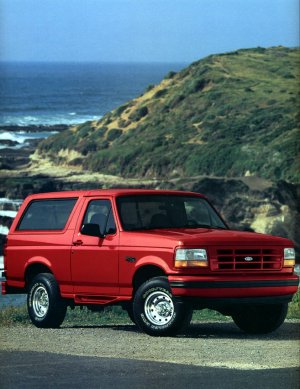
I have a 1995 white 5 speed Bronco XLT (I was told that it is the "Bright White" model but not sure if that really exists) with a 5L engine in it -
Recently the AC blower motor started to make a nasty noise so I replaced it. While the noise went away with the new blower motor so did the air volume. As I move the fan speed switch from the low to high positions it does speed up but the volume of air pushed out never matches the old motor when it was working well. Since I was at it I also replaced the resistor and that hasn't helped. I've also done other things like clean out all the gunk (twigs, leaves, & etc) in the housing that holds the fan but nothing has helped.
Any suggestions what to do/look at next would be appreciated!
Mike
Abq, NM

#2
Posted 19 June 2010 - 06:09 AM
Is this with AC On and also with no AC or defrost?
Because of;
A/C Switches to Defrost in MAX Mode; "...If MAX A/C only blows out the defrost registers, or if it switches to defrost during hard acceleration, this vacuum line (to the recirculate motor) is the reason. The white plastic is far more susceptible to UV light than any other color, and the gap along the edge of the hood allows it to degrade..." Source: by Steve83 (Steve, That dirty old truck) at SuperMotors.net
Here is 92-96 HVAC Vacuum System by Ford via Steve
-- Next up is to go thru this & determine if all is op. correctly;
Air Conditioning Controls for '92-96 A/C by Ford via Steve
Air Conditioning Controls for '92-96 A/C
"OFF
In the OFF position, all doors are in the vacuum-applied position with the exception of the PANEL door. The blower & compressor clutch circuits are not energized.
MAX A/C
In the MAX A/C position, all vacuum operated doors are in the vacuum position. A/C damper inlet door (19C802) air is shut off and the passenger compartment air is recirculated to maximize cooling. Discharge is through panel register. A/C clutch & blower circuits are energized.
NORM A/C
In the NORM A/C position, outside air is allowed to enter the passenger compartment. The air passes through the A/C evaporator core (19860) and is cooled before reaching the passenger compartment. Discharge is through panel register. A/C clutch & blower circuits are energized.
VENT
Ventilation is delivered through the instrument panel registers when the function selector knob in the A/C control (19980) is set in the VENT position. In the VENT position, no vacuum is applied to the OUTSIDE/RECIRC. vacuum control motor (18A318 ) and the door is open to the outside. The air coming in through the cowl is discharged through the panel registers. The blower circuit is energized, but the A/C clutch is not.
FLOOR
In the FLOOR position, no vacuum is applied to the vacuum control motor and the OUTSIDE/RECIRC. door is open to the outside. Air is discharged through the heater outlet floor ducts (18C433) with a small amount going to the windshield defroster hose nozzles (18490). The blower circuit is energized, but the A/C clutch is not.
MIX
In the MIX position, outside air is discharged through the windshield defroster hose nozzles and the heater outlet floor ducts. A/C clutch & blower circuits are energized.
DEFROST
In the DEFROST position, outside air is discharged through the windshield defroster hose nozzles with a small amount going to the heater outlet floor ducts. All doors are in the no vacuum position. A/C clutch is engaged in ambient temperatures above approximately 10�C (50�F) & the blower circuit is energized.
The PANEL/FLOOR, FLOOR/DEFROST and OUTSIDE/RECIRC doors are vacuum operated.
For maximum cooling, the temperature knob should be set in its fully counterclockwise position; the function knob should be in the MAX A/C position; and the blower motor (18527) should be set for a desired rate of airflow.
Even though the function knob is on MAX A/C, the temperature knob, being manually controlled, may be set to modify the temperature of the air and the path through which the air flows. Another characteristic of the MAX A/C setting is the increased noise level of the blower motor. Speed does not change when the OUTSIDE/RECIRC. door is moved to either of its two positions. The difference in noise level is that an open recirculation door exposes the passenger compartment directly to the noise. When insulated against the noise with the recirculation passageway closed, the speed appears to be less.
The control knob operates an A/C switch that is attached to the backside of the A/C control by one screw and retainer tabs.
Five hoses (black, white, red, blue, yellow) extend from the A/C control just below the electrical connector for the mode selector switch to the vacuum control motors and vacuum supply. The solid black hose goes to the vacuum supply through a tee-shaped A/C vacuum check valve (19A563), which attaches the A/C vacuum reservoir tank and bracket (19A566) and engine source. The white hose actuates the OUTSIDE/RECIRC. air door two-position vacuum control motor. The blue hose actuates the FLOOR/PANEL air door two-position vacuum control motor. The red and yellow hoses actuate the FLOOR/DEFROST three-position air vacuum control motor. Each end of each hose slides onto the nipple of the vacuum port to which it attaches..."
I've seen some pure junk parts recently coming out of Ch...
I ghad to throw away a new Purolator Classic Air Filter
Part No. A24378 because the gasket was TOO big and there was a large gap between cover and intake side of the filter; also junked new ANCO brand wiper refills because they fell apart as I tried to get em to fit. They used to be a GREAT BRAND. same for my JD tractor wheel bearings.
If it wasn't a Motorcraft fan; return it for http://www.rockauto....o.php?pk=379250
Motorcraft® Blower Motor Highlights Include:
They are built for specific vehicle applications for simple, bolt-up installations for shorter installation times.
To ensure proper operation, the motors are tested for current draw.
Warranty Information
Alternate/OEM Part Number(s): E9TH19805AA, F2TZ18527A, F4TH19805AB
the key is the size/# of copper windings; the junk brands prob use alum in lieu of copper
If you have a diggie Multimeter with AMP capability; I'd like to see what that fan draws in all the settings and then compare it to the Ford MC fan's draw.
This post has been edited by miesk5: 19 June 2010 - 06:25 AM
96 Bronco, E4OD, Man Xfer Case & Hubs
Thanks to All Who Serve
#3
Posted 19 June 2010 - 06:28 AM
Thanks for the quick reply - I can get my hands on a multimeter that does amps but not sure what to measure. Do I just connect to the leads that go to the blower and report those for each of the switch settings? By-the-by, I got the blower and resistor from NAPA.
One other thought - I spliced in a proper power socket for the fan, the last one was wired directly without plugs, and used come clamps I got at an auto parts store to connect the wires. Is there a "proper" way to do an electrical splice on a truck like a Bronco? I've run into electrical issues before on my Fords and know that those connections are important.
Thanks -
Mike
#4
Posted 19 June 2010 - 10:06 AM
mwfolsom, on 19 June 2010 - 07:28 AM, said:
Thanks for the quick reply - I can get my hands on a multimeter that does amps but not sure what to measure. Do I just connect to the leads that go to the blower and report those for each of the switch settings? By-the-by, I got the blower and resistor from NAPA.
One other thought - I spliced in a proper power socket for the fan, the last one was wired directly without plugs, and used come clamps I got at an auto parts store to connect the wires. Is there a "proper" way to do an electrical splice on a truck like a Bronco? I've run into electrical issues before on my Fords and know that those connections are important.
Thanks -
Mike
In regard to splicing, I would recommend either properly crimped, "But splices", or soldering. The type of splice that cuts into the insulation can not be totally depended on for good connections.
Soldering depends on where the splice is located. If it is at a place that the wire will experience flexing, then don't solder, it will eventually break off.
If it can be immobilized then I would solder. For small wires, there is no better electrical connection than a properly made solder connection. That assumes that one knows how to make a proper solder splice.
You might want to consider removing the dash cap and check for debris that may have collected in the duct work. I was having problems with air flow to the driver side and found quite a bit of leaves and maple tree junk in the duct work. There was probably no need to replace the OEM resistive setup for controlling the motor speed, it is not likely to have gone bad.
Good luck,
Parts replacement is not trouble shooting, replacement follows trouble shooting
Broncos are MPVs not SUVs
Communication: I know you think you know what I said, but what you need to know is, I didn't say what I meant.
Some of my pictures at Supermotors http://www.supermotors.net/212
1983 Full Size Bronco with; Ford 8.8" 3.08:1 Rear; Dana 44 3.08:1 Front; WARN Premium locking hubs; 31x10.5's; NP208; Holley 4160 4bbl; MSD 6AL Ignition; MSD Blaster 2 coil;
1978 Saginaw Pump V-Belt Power Steering;
1984 F150 Dash;
1985 351W HO;
1985 Tilt steering wheel;
1993 Mercury Sable 3G 130 Amp Alternator;
1995 F150 doors;
1995 20 inches of rear portion of the tub;
1996 Bronco tail gate;
1996 Eddie Bower Over Head Console;
1996 Lincoln Mark VIII 4200 CFM Electric Fan;
Headlight harness upgrade; DRLs; Battery relocated to rear; Under hood fuse box vs fusible links; Upgraded wiring for rear window to 10 AWG;
Always under restoration
#5
Posted 19 June 2010 - 04:39 PM
yw
ok, this site won't allow images of the schematic to post!
let's see if this works...........
Fred gave ya da skinny on the connectors, which is what I'd do too.
I don't have a 95 wiring diagram, so let's try a 96
Disconnect O/BK (orange/with black stripe) & connect the MM in series between:
O/BK (orange/with black stripe), MM - lead
and motor, MM + lead
Hopefully, I got this right because current flows from Fuse thru Function Selector Switch (Vent, Normal AC, MAX AC. etc.) to motor and then to R pack (exc for high speed) then thru Blower Motor Speed switch and then to ground.
Three of four operating speeds (LOW, MEDIUM LOW and MEDIUM HIGH) are controlled by a heater blower motor switch resistor connected in series with three of the operating positions and the ground. The MEDIUM LOW and MEDIUM HIGH positions on the heater control are identified by dots on the control.
With the heater blower motor switch in its LOW position, current flow in the ground circuit passes through three of the coils in the heater blower motor switch resistor. In MEDIUM LOW, current flows through two coils. In MEDIUM HIGH, current flows through one coil. In HIGH, current flow in the motor ground circuit bypasses the heater blower motor switch resistor to provide maximum speed.
=========
As for the Bright White;
Color Code Location, Bronco, 85-96; "...1985 and Newer is on the driver door. There will be a white sticker. Towards the bottom of the sticker in the left hand corner it will say paint. This is decieving because underneath of the word paint is the body style code. What you want is the 2 digits or letters above the word paint..." Source: by levineautoparts.com

Code Label pic
Source: by automotivetouchup.com
Is the Bronco a Sport model that is all white incl Bumpers, w/s trim, door handles etc.? As shown here on Page 6 of
Brochure, 95 Bronco Source: by Ford via Hans Tore Tangerud @ lov2xlr8.no

95 Bronco Sport
on pg 8 you'll see the colors;
Lt. Opal Clearcoat Metallic, Oxford White Clearcoat, Colonial White Clearcoat
96 Bronco, E4OD, Man Xfer Case & Hubs
Thanks to All Who Serve
#6
Posted 20 June 2010 - 04:42 AM
Last night I forgot to ask if you still have the old blower motor.
If so, then we can compare amps; otherwise why test the new motor since Ford nor aftermarket suppliers provide amp data?
I went thru Fords/ AC/Heating Catalog and the specs are gone for our old Broncos.
My fuse for the Heater Blower is 30 AMPS!
So... now we have to figure how much it actually draws.
I forgot to add too that my dig MM amp feature allows hook-up without worrying about polarity; so it's ez for me to check current draw without knowing where the+ lead should be placed. BUT my MM had a fused ckt in the Amp range for a max of 10.0 amps.
for posterity
Air Conditioning & Heating Parts Catalog, Bronco & all Fords w/Ford Part Numbers & Illustrations 108MB PDF Source: by fordinstallersupport.com
See page 134
BLOWER MOTORS ---- Ford PN (short version & long)
1996-90 AC & Heater - MM-527 F2TZ-18527A
1989-87 AC & Heater Exc.w/Aux.Heater - MM-527
1986-82 w/Factory AC - MM-891
w/Heater Only Exc.Aux - MM-410
1981-80 w/Factory AC - MM-891
w/Heater Only Exc.Aux - MM-427
1979-78 w/Factory AC - NA
w/Heater Only - MM-427
1977-66 w/Heater Only - MM-427
96 Bronco, E4OD, Man Xfer Case & Hubs
Thanks to All Who Serve
#7
Posted 20 June 2010 - 05:05 AM
General
Insufficient Airflow from Dash
Many different things can affect the volume of air that flows through the air distribution
system. The condition of the blower motor, blower wheel, and the air distribution system
itself determine the volume of air that flows out the vents.
Air is drawn in from the outside of the vehicle through the use of a blower motor and
wheel assembly and is then forced across the evaporator (on A/C equipped vehicles) into
a large open area called a plenum. Airflow is then directed from the plenum to the areas
requested by the opening or closing the designated air mode doors.
The blower motor and wheel assembly has to operate properly in order to pull and push
the correct volume of air through the air distribution system and vent outlets.
• If the blower motor has a problem, it will present itself as an increase in the amperage
required to turn the motor.
• Refer to the OEM information for the correct amperage specification.
• If the blower wheel is turning the wrong direction or has become loose on the blower
shaft, the volume of moving air will be dramatically reduced.
A number of conditions can develop which diminish airflow in the plenum and air
distribution passages. These conditions result in a restriction in airflow from the vents.
• Duct & Door seals on older vehicles can cause leaks behind the dash.
• Trash drawn into or placed into the air distribution assembly passages.
• Material such as leaves, or animal hair, on the blower motor side of the evaporator.
• Large rodents (squirrels, rats) have been known to build nests in the evaporator case.
• Investigate for some environmental condition, such as to where they park the vehicle,
that would cause anything to be drawn into the system
Materials being placed or collected in the system, most often occur when the vehicle has
been parked for an extended period of time or is located in a rural area. Also Remember
that many of today’s vehicles utilize filter assemblies that have specific replacement
intervals, which if overlooked can result in limited airflow.
On vehicles without a filter cartridge the removal of the blower motor is the first step in
the inspection and repair process. Refer to the OEM information for removal and
installation procedures. If the restriction can not be repaired with the removal of the
blower motor, then the removal of the evaporator may be necessary.
Care should be given when locating the restriction. If a rodent has built a nest in the
evaporator case, the rodent may not be happy with your attempt to remove the nest.
Thick gloves should be worn when trying to remove debris from the evaporator case.
They show dimesnions for the motor, but no current draw
Description Value
Type Blower Motor
Type Blower Motor /Flanged
Connector Type 2 Lead Wires
Motor Dia. 3-1/4"
Motor Length 4-7/16"
Rotation REV
Shaft Dia. 5/16"
Shaft Length 1-5/16"
Voltage 12
96 Bronco, E4OD, Man Xfer Case & Hubs
Thanks to All Who Serve
#8
Posted 22 June 2010 - 11:48 AM
ya know sumptin'? I just read-over my replies and realized that a paragraph is missing! I have Comcast conn issues; majot lag time that seems to cycle according to clouds, rain in mexico, etc. So at times, when i llok at where the cursor is on the page, it really is somewehere esle and thus, I over-write.
So;
am wondering if a panel door is askew
look @ blower motor in upper right corner
flow thru outside/ recirc air then to the left (below Cowl Panel line)
past heater core
and past evap door
thru Diverter Panel Door (check that one)
and to instr panel registers.
as Steve83 wrote elsewhere yrs ago; "...The diverter door (panel, defrost, floor) is totally independent of the blend door (hot/cold), and it's vacuum-operated, so it'll always be slow; ..."
or
if white vac line is broken - then air will be diverted to defrosters...as Steve83 wrote; "...If MAX A/C only blows out the defrost registers, or if it switches to defrost during hard acceleration, this vacuum line (to the recirculate motor) is the reason. The white plastic is far more susceptible to UV light than any other color, and the gap along the edge of the hood allows it to degrade..."
96 Bronco, E4OD, Man Xfer Case & Hubs
Thanks to All Who Serve
#9
Posted 23 June 2010 - 09:43 AM
I was able to break open my 96's EVTM/PCED for a min here and got the specs on Blower Motor Current Draw and Voltages in 1996 Bronco-F-Series Workshop Manual
ELECTRICAL SPECIFICATIONS Blower Motor Current Draw and Voltages
Switch Setting:
Amps / Volts
Low 3-5 / 3-4 volts
Medium Low 6-8 / 5-7 volts
Medium High 10-14 / 7-10 volts
High 15-22 / 11-14 volts
Control Assembly, Illumination One ICP-161 Bulb
Blower Circuit System Protection 30 Amp Mini-Fuse (Light Green) in Panel F-14 (D9ZB-14A094-GA)--
-----
also;
Floor Panel Door, Temperature Blend Door (Cable Controlled), Floor Defrost Door etc, in Parts Break-Out Diagram in in 1996 Bronco-F-Series Workshop Manual
http://www.thediesel...ages/m4193e.gif
http://www.thediesel...tj/stjc2009.htm
V = Vacuum.
A = Atmosphere
This post has been edited by miesk5: 23 June 2010 - 09:48 AM
96 Bronco, E4OD, Man Xfer Case & Hubs
Thanks to All Who Serve

Sign In
Register
Help

Add Reply
MultiQuote